Most valuable thing for me in that interview was this pearl on how a successful person raises kids. We do the time outs, but I had never thought of the bathroom. Great idea.
> I think the kids have grown up really well, and I don’t think it hurt them that we had rules in the family that were fairly strictly enforced (usually with a five-minute timeout in the bathroom). We had a very strict “no whining” rule, for example, and I’ve seen kids that should definitely have been brought up with a couple of rules like that.
> That said, maybe they’re just naturally good kids. I don’t remember the last time I sent them to the bathroom (but it’s still a joke in our family: “If you don’t behave, you’ll spend the rest of the day in the bathroom”)
My sister had her children trained. If they whined, she would ask, "What do whiners get?" They had to yell back, "Nothing!" (Or the siblings would do it, if the whiner was too pouty.)
"what’s even more interesting than improving a piece of software, is to improve the way we write and improve software. Changing the process of making software has sometimes been some of the most painful parts of software development (because we so easily get used to certain models), but that has also often been the most rewarding parts. It is, after all, why “git” came to be, for example."
Exactly! with so many frameworks, platforms, languages and what not floating around this is getting more and more important. Yet, AFAIK, truly innovative approaches like Light Table are rare.
OCaml would also work, if you can find the libraries. Or Haskell, if you can wrap your head around enumerator and iteratee IO. (Not saying that those are the best choices.)
By the way, git was originally written in a mixture of C and shell-code. They replaced most of the shell code.
Speaking as a (Common) Lisp fan, Lisp is obviously hardly a good choice for Unix application -- it's completely orthogonal to Unix philosophy, and major modern free CL environments integrate pretty bad with Unix (I'm talking about SBCL and Clozure). It's especially bad for console tools like git, where loading multi megabyte core image every time is unacceptable.
You know, it's not in the same class as a macbook air, but my Thinkpad x61s has been my tiny performant champ for 4 years now. Roughly the size of the netbooks of the time, but tons more power than a netbook and the initial macbook air means it's still powerful enough for anything I throw at it. The one bummer has been screen resolution, but I still get 6 hours battery life on it (I did have to replace the battery once), and it was just a bit over three pounds with the larger battery.
I will say that Apple did a good job on the screen resolution of the Air line, although the lack of 8gb option for memory is a pain.
My biggest problem with non-Apple "ultrabooks" (thx Intel) is the weird off-center keyboard / touchpad. It is really hard to find a keyboard / touchpad that is actually centered. Never-mind Sony putting a numeric keypad on theirs. How am I supposed to sit centered to the screen and type properly? It looks like that thinkpad is centered but it is so hard to tell with the angled shots.
Control + D works nearly everywhere as well. Incidentally, now I really miss the Fn + arrow for pg up/home/end/pg down when I use a full size keyboard.
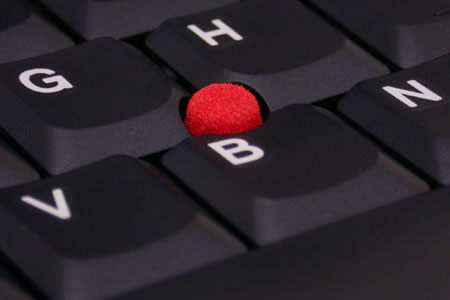
How do you get by with the trackpoint/trackpad? (my current thinkpad has both)... my experience has been that the trackpoint still (to this day over a dozen+ years after it was introduced) still exhibits ghost motion, and the trackpads on PCs all still suck at palm rejection and responsiveness while typing.
When I want an super-portable laptop in "lap mode", I need the pointing device that doesn't suck. The only one that delivers is the Macbook. With all my PCs I've needed to connect a mouse for decent productivity, which really sucks for portability.
> ... and the trackpads on PCs all still suck at palm rejection and responsiveness while typing.
FWIW: this is not a hardware problem. This is an issue with trackpad drivers on PCs, which have been shit since the dawn of time.
I'm typing this from a MacBook Pro running Arch. It took me quite some time to configure the trackpad so that it was comfortable and half-usable. There's a driver for X called "mtrack"[1] which handles clickpads (i.e, where the entire trackpad surface is a button) properly. It's a more configurable fork of the "multitouch" driver that comes with most popular Linux distros these days. It does tap-to-click, tap and drag, drag lock and multitouch just fine. mtrack's palm detection is better than most trackpad drivers, but still not perfect, which is why I ended up having to turn off tap-to-click entirely because I'd get accidental mouse input while typing even with the trackpad sensitivity turned way down.
Now my trackpad works great. I still can't use guestures, though, because (1) X has shitty guesture support and (2) the GNOME folks haven't yet added guestures to Shell. The situation will (hopefully) be fixed with a future release of X and GNOME. I did get some guestures working using an unholy combination of xbindkeys, xdo and a Python script, but it wasn't worth it.
If you're running Windows on your MacBook and using Apple's drivers, you're fine. OTOH, if you're using a non-Apple notebook running Windows and your trackpad vendor doesn't give a fuck about writing good drivers, you're totally and utterly screwed.
This same trackpad works flawlessly on OS X. Clearly, the folks at Apple have spent a lot of time analyzing trackpad input patterns and determined the types of input that should be ignored.
Oh boy. We really need to push this into X as soon as possible. Not only it would make using Linux on Apple hardware halfway decent, it could also help pretty much every other laptop out there.
yep, after you use the clitmouse of a loooong time (mostly after I play a round of league of legends) and you try to move the cursor just slightly, it will ghost a little down or up. just pressing the red cap once will stop it until after the next game session.
but it's a damn small price to pay for the clitmouse.
no self respecting programmer should use any other mouse device. my bottom touchpad is configured in X to be 100% scrolling
>no self respecting programmer should use any other mouse device.
Hmm... I find the touchpad nothing but a pain. but that may be becoz of my hand position while typing. it keeps shifting the cursor. But other than that, i have developed a distaste towards reaching for the mouse. sometimes it's absolutely necesary, but i am on a mission to setup software to use my computer mouse-free. (i.e switching to a tiling window manager,etc..) but looks like that's too hard/unnatural
I am using my laptops for more than 10 years without a mouse. I am so happy about this decision that I made ago - it is definitely possible and gives a boost of productivity and if you are traveling you do not need to care with you a mose. But it comes with a dependency - all my laptops need a trackpoint, and the best ones by far are on thinkpads. Before going mouse free I had to learn blind-typing (10 fingers, without looking at the keyboard). Then I started to learn VI(M) as editor and at some point it became so unnatural to move the hands from the keyboard that I started to use less and less the mouse until I realized that I do not need it at all.
I already do blind-typing and infact the unnaturalness of reaching for mouse is what makes me wanna go mouseless. I really haven't tried thinkpad after i moved to blind-typing. and sometimes do wish for it. Am curious How big of a dependency can a trackpoint become?? am i just naive to think keyboard operations should be sufficient enough??
I feel that no self-respecting person would use that term, especially on the semi-professional HN site. It's distracting from your technical advice and overly dismissive opinion of people who do things differently from you.
I'm working on modding some Thinkpads (X61, X121e, possibly X220 if the price works out) and selling them with Ubuntu pre-installed and fully tested. If anyone's interested, please sign up here - http://giniji.com/ubuntu_laptops.html.
The hardware spec will be better - SSDs, maxed out RAM - and at a better price than Lenovo offers.
The machines will be fully tested to make sure important things like graphics work well, battery life is maintained and suspend/wake works reliably.
You will also be able to choose your desktop (Unity, Gnome, KDE, XFCE) and ask for additional software to be installed (like Dropbox, not Norton Anti Virus ;-).
Please check back on the site next week and the full product details will be up.
If it weren't for the brightness (no LED backlight) issue, I would have a stockpile of Thinkpad X61s in my closet because I would want to use that machine forever. As it is I'm terrified that something will happen to my X200s and I won't be able to buy anything without a 16:9 screen.
yeah the x200 series was a step up in the display. I had gotten the high brightness screen on the x61s which meant that it wasn't as horrible as the other one.
I've dropped my x61s three or four times now from substantial heights, and a little bit of the plastic is cracked and lately it seems like the cables to the screen might be getting sketchy, but after I pulled apart all the keys and cleaned it out really good a couple of weeks ago it still feels (and looks) new. It's the perfect laptop for traveling at this point, enough power and battery life and low enough weight for anything, but it's old enough that if something happened to it, it wouldn't be devastating.
While learning my way around arch, I got a very cheap second hand "Let's note" panasonic notebook[1]. The screen is, admittedly, pretty naff but as a small lug around which I don't care too much about, it does its job admirably. Debating whether it's worth it to stick an SSD in it now I splurged and got a macbook air..
Uh oh! Haha.. It's a cf-r4 I got for under 15000 yen off of
Yahoo auction Japan because it didn't have a charger. Went to akihabara and got a replacement..
nobody is immune to marketing. Not even linus torvald.
thinkpads are ok (if you stay in the T series) and asus eeepc1000 was years ahead of any mac at the time. heck the air is a copy of that machine with a less plastic-ey case.
but neither asus nor lenovo buy billboards in times square and hollywood blvd, or center fold wired.
anyone that swears to buy apple after researching for the best is just a sad victim of marketing. Sadder as they will never accept it.
>anyone that swears to buy apple after researching for the best is just a sad victim of marketing. Sadder as they will never accept it.
The quality is not about the cpu/ram/hd specs (which are mighty fine in the MBA). Are those other computers as thin? As light? Some are? Cool. Are those also made of a solid chunk of aluminum? No? Bad. Do they have the highest quality touchpad? No? Bad. Do they feature a very usable "chicklet" keyboard? No? Bad? Do they have the same resolution and display quality? No?
But it's telling you say that "air is a copy of" eeepc1000. It's nothing like eeepc1000. Actually all the "media pundits" were waiting and asking Apple to produce a netbook like it, and they never did, they made the MBA.
Unix is great because everything is a file. Except when it's not so great. By far the best part of the article:
"The one really memorable “Oh sh-t” moment was literally very early on in Linux development, when I realized that I had auto-dialed my main harddisk when I meant to auto-dial the university dial-in lines over the modem. And in the process wiped out my then Minix setup by writing AT-commands to the disk that understandably didn’t respond the way the autodialling script expected (“AT commands” is just the traditional Hayes modem control instruction set).
That’s the point where I ended up switching over to Linux entirely, so it was actually a big deal for Linux development. But that was back in 1991."
They seem to completely ignore the existence of ultrabooks. They say that nobody is making thin and light laptops other than Apple, but my thin, quiet, slightly lighter, cheaper, and higher-resolution Zenbook would beg to differ.
Honestly (and I say this as a card-carrying Apple hater) the Macbook Air is an Ultrabook. The term "ultrabook" is Intel's attempt to push PC vendors in that direction via branding. But the form factor was fundamentally Apple's innovation, and they got there three years early.
But yes: some of the recent ultrabooks looks really nice too, and the upcoming ones look even better. I'll probably buy one once someone gets a 1920x1080 display on a ~13.3" screen (I know there's a Vaio Z that does this, but it's a little old and not thin enough to qualify).
Slightly off topic, but does it annoy anybody else that when TVs "upgraded" to 1920x1080 as de facto standard, computer screens were downgraded from 1920x1200 as a consequence? Why do computers need to be 16:9 all of a sudden??
Laptops are still used as a media device for many, so mimicking the resolution of televisions makes sense in those cases. Personally, I prefer a 16:10 screen because I spend more time programming than watching videos on my laptop, but I'm sure there are plenty that beg to differ.
You can still buy laptops with 16:10 aspect ratio, but I think the people that explicitly prefer it are the minority at this point. I'd say most people don't really care.
> Laptops are still used as a media device for many, so mimicking the resolution of televisions make sense in those cases.
Actually, laptops as media devices is an argument against having the same resolution as televisions.
When one watches a television, one generally operates the television and media source via a remote control, which has dedicated buttons for most functions.
When using a laptop for a media device, one generally does not have a remote control. The controls are usually done as on-screen controls that you manipulate with the pointer.
Hence, for a laptop used as a media device, 16:10 makes more sense than 16:9, because it provides room for the controls outside the video.
Aren't the on screen controls almost always hidden? The only time I could see them actually getting in the way would be while adjusting the volume, but I'm fairly certain most (if not almost all) laptops come with hardware volume buttons nowadays anyways.
I've heard the excuse that they have to buy LCDs from companies whose primary customers are TV manufacturers. The end result is the same of course, but the laptop manufacturers would have to cut their LCDs in shapes that would result in waste to produce machines with reasonable aspect ratios. (Of course what this means practically is that I'm just not going to buy a new computer, so whatever.)
Everybody says this, but it doesn't make any sense. They don't sell 1080p TVs at small screen sizes. A 15" or 17" 1080p panel is not getting sold to a TV manufacturer.
I truthfully think that the fault for this lies entirely with the consumer. People got used to/ were told that widescreen 16:9 setups were like being in the movie theater, and therefore better. I don't much like this, however I don't speak for the largest demographic of people that actually buy monitors.
I do know that I much prefer gaming and coding on a square display.
I suppose the issue is slightly deeper than "users want to see their movies without letterboxing"
Sure, you could simply slap any resolution in a PC monitor.
But if you keep the aspect rate constant across devices, you can easily change displays. Why? Example: 2nd monitor, and especially the big screen TVs that are being used in place of projectors nowadays.
Funny that the 13' MacBooks (Pro/Air) still have a 1.6 (16:10) ratio, and the 11' has a 16:9 ratio
It's really only the 2010 Airs onward that are "ultrabooks", and intel had prototypes circulating at tradeshows that were approximately that form factor in the summer, before Apple announced/released that line.[1]
So, it wasn't really Apple's innovation, it was just yet another case of them doing it better and faster.
But that's mostly a semantic game. The early Air obviously doesn't qualify for Intel's branding, being based on a different technology base. But that's just a feature list. Intel can't be credited with inventing the "Ultrabook" on the basis of requiring some maximum thickness, battery life, or CPU brand. Certainly the idea of an ultrathin laptop came from Apple; Intel grabbed it later as a good way to sell CPUs.
Of course not. Apple shipped the first ultrathin laptop. And that kind of product turned out a few years later to be really attractive to Intel, who put their own branding and initiative on what was essentially the same idea.
I'm not crediting Apple with anything breathtaking, I'm doing the opposite: pointing out that the "Ultrabook" is really just a clone of the Macbook Air.
I had a fanless 12'' notebook that weighs less than 2 pounds long before the Air: a Dell Latitude X1 (which is really some Samsung notebook whose name I can't remember).
  * ultrabooks often seem cartoonish and feel cheap
  * not much cheaper than Apple's offerings
  * included software not equivalent
  * battery life not as great
Of course you could argue that some of these things are because Apple is in the unique position of creating the hardware and software, but so what? That's part of the point...
Um... I'm never one to shy away from a good platform flame, but your linked article doesn't say anything like the bullet list you provide. It's not even close; it's actually a very positive review on the whole. What you just posted amounts to pure distortion; you're basically lying your face off. Stop it.
* "Body is cartoonish and feels cheap:
* "$300 less than the comparable model at $1,299" (from me: compared to the "Apple Tax" on the MacBook Pro, 25% seems almost reasonable)
* Bad: "Pre-installed software is abundant, in-your-face"
The article mentions battery life is 6 hours (comparable Air rated at 7 hours), which could be read as "similar" or "not as great".
And the description of the S3 touchpad is more "finally, it's bearable" than "enjoyable to use."
Gonna have to agree with the grandparent on this one. Though it IS a positive review on the whole, that's partly because previous-generation windows thin & lights have been pretty bad. (Recall that the previous-generation Air had its problems as well...)
You're right, I should probably retract the "lying your face off" bit. The points are ... supportable.
Still, cherry picking virtually all the bad points out of what is clearly a very positive review[1] to support a decidedly negative "short version" for an online argument is just terribly dishonest. Please. You two should be ashamed of ourselves. Either make points of your own or stay silent, don't claim that Ars Technica said something they quite clearly didn't.
[1] It amuses me greatly that you try to spin even that. Oh, they're only saying positive things because you know (somehow, from facts not apparent in the article) that they really mean them in a negative context by comparison with a piece of hardware they aren't reviewing. You should consider going into politics.
I wasn't trying to get into a Mac vs. PC argument here. I was strictly pointing out that saying Apple was the only one making thin and light laptops is just plain wrong. That being said, your oversimplified "short version" of the reviews of all ultrabooks reeks of Apple bias, and my own experience with the Asus Zenbook contradicts all of your bullet points (except the included software not equivalent...I'm not sure what the Air comes with).
> Of course you could argue that some of these things are because Apple is in the unique position of creating the hardware and software, but so what? That's part of the point...
Linus uses Linux on his macbook air so that doesn't really matter.
Did he say that? I don't remember reading that, and he didn't mention it in the article. Maybe he's just using the Mac to access his Linux machine remotely? :)
The zenbook is a nice machine, but the term ultrabook has become so diluted as to be near meaningless now. There's 15" laptops with optical drives being marketed as ultrabooks.
I believe he cashed out quickly (before the stock tanked during the crash) unlike ESR who just wrote articles about how awesome it felt to be a millionaire and then watched his money disappear.
I remember at the time on Slashdot the comment du jour was that Torvalds dumping his RHT did not reflect well on the future of Linux as a product. Not a popular view, although obviously RedHat eventually came back with a vengeance. The problem was that the stock was incredibly inflated, so I was always of the opinion that it was the right thing to do for him.
I have some good story too.
Once I met one of the top apache foundation guy in Sri Lanaka while he is in Apache Road Show Asia.
So I asked him why do you use Apple (a mac book) and try to promote apache (he promote FOSS while using anti-FOSS tools)
He said me, Laptop is just another tool for me. I don't want to buy a IBM and install Linux and work hard for get it worked.
He also said that, time he saved is more worthy than $2000 dollars spend my his mac-book
That's funny, the above reason is exactly why i've a Vaio Z.
Can't be bothered with the crap you have to do to get Linux to work on Mac.
It was working out of the box on the Z (i dont use the media dock)
LT using an Air surprises me because of the lack of screen real estate. I dislike coding at 1280x800 (but I'm usually using Eclipse these days). Heavily customizing Compiz has made 1680x1050 bearable with Eclipse, but I prefer the 1920x1200 dual monitor setup.
LT would probably say something akin to, "real men don't use IDEs."
I'll go for super portable when they put 1920x1200 into a 12" inch screen. (I won't have issues with reading at that density.)
For the record, the 11" Air is 1366x768. That resolution will comfortably hold two side-by-side Emacs buffers. (1280x800 won't hold 80 characters-wide side-by-side buffers under the default Ubuntu font, but decreasing the font size by a notch will make it fit.)
For what it's worth, there does exist a 1600x900 12.1" screen in the Panasonic SX. Also there's an ASUS transformer tablet (or something), maybe not yet out, that has a 1920x1200 resolution in something like a 10" screen.
Second. I was stoked about Retina display, not because it was an actual retina display IMO, but because you didn't have "pixels the size of gorillas," so to speak.
Another way of looking at it is that the new iPad has 2048x1536 on a 10" screen - and yet despite this, even your genetic inferiors can read what's on it...
I've never used one, but Sony's Vaio Z23 has a a 13" 1920x1080 screen, which comes close (and is lighter than a MacBook Air). It's also staggeringly expensive.
If the rumours are true, Apple will release a 2560x1440 (2560x1600?) laptop in the foreseeable future, though.
I can agree with this. I've been waiting and still am for something. I really would like to see that iPad screen on a laptop. It's 10" yes, but on the road code would be so much better. I can plug it into a monitor when at home or work.
I agree with him on hardware.
Except I use a 13" Vaio Z.
Which also happen to compile Linux about 5 times faster than his mac - cold and hot. And also be lighter. And it's silent (except during compile). I really mean silent. Can't hear it - at all. And has a better screen. Yada yada. So it doesn't look as nice as the mba but its not that bad. And the inside, uuh.
The vaio looks good too. Too bad sony decided to screw us and only sells the i7, 8, 256, 1600x900 version here, and it costs about twice the money macbook air does, while including fairly unnecessary stuff like 256 GB SSD.
And I can't buy it in any other country, because Sony won't sell notebooks with english keyboards anywhere not US or UK.
> The free availability of Linux on the Web swiftly caused a chain-reaction leading to further development and fine-tuning worth the equivalent of 73,000 man-years. […] Linus Torvalds’ achievements have had a great impact on shared software development, networking and the openness of the web, making it accessible for millions, if not billions.
Wait a minute, shouldn't we credit Stallman for this chain reaction? Without the GPL, Linux would probably have stayed proprietary, and unsuccessful. Without the GNU system, computing would probably be much less open than it is now (I don't know what the impact on BSD would have been, though).
It seems that saying "Linux" instead of "GNU/Linux" has a significant impact after all. Or did Stallman got this very prize before Torlvalds?
Must I remind you that the FSF wrote the fucking Gnu Compiler Collection? It made available a high quality compiler for free (both meanings), and used the GPL to keep it that way. It had a great impact on the expectation we now have for language implementations (namely, they should be free).
Linux is traditionally build with GCC if that's count for anything. The fact is, these days, it's quite hard for Free Software to escape GCC. LLVM didn't take over the world yet.
Richard Stallman may be ugly[1], old, and asocial, but he's not irrelevant.
[1] You'd be surprised how much it counts. Compared to him, Linus is hot.
A bit exaggerated. The direction Android has taken really rubs me the wrong way. The hot new phone is obsolete after 3 months and stuck with an old OS unless you root. It's not a trend I can appreciate the way I did when Android first surfaced.
I never understand this argument. How is an Android phone more obsolete than an iPhone after 3 months? Technology progresses just as fast in both cases.
I think he was referring to the fact that many Android phones don't receive updates after the first few months, whereas iPhones are typically receiving updates at least 2 years after release.


> I think the kids have grown up really well, and I don’t think it hurt them that we had rules in the family that were fairly strictly enforced (usually with a five-minute timeout in the bathroom). We had a very strict “no whining” rule, for example, and I’ve seen kids that should definitely have been brought up with a couple of rules like that.
> That said, maybe they’re just naturally good kids. I don’t remember the last time I sent them to the bathroom (but it’s still a joke in our family: “If you don’t behave, you’ll spend the rest of the day in the bathroom”)