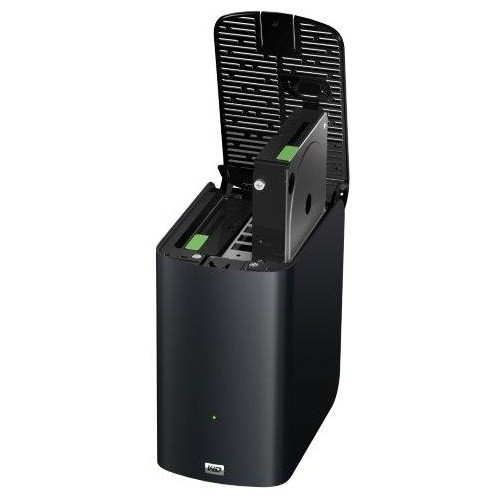
I think the issue here is "end of life" is defined way too soon for portable hard drives. The mechanical parts have a 4% annual failure rate, or a half-life of 12.5 years. The software should be supported for that long.
I think that we need to separate the life of the hardware (WD My Book) and the life of the cloud service (the "Live" bit).
The drives themselves and their function as a NAS on a LAN is still fine.
When "Live" EOLed, they should have turned off the servers and disabled the function. If they weren't going to service/support it anymore, then they should have been honest about it.
Of course, their consumers would have screamed, so they did the worst possible thing, kept the service running as-is and didn't make it clear that people were leaving themselves open to attack.
> I think that we need to separate the life of the hardware (WD My Book) and the life of the cloud service (the "Live" bit).
That makes me think of the internet radio owners (Grace Digital, Yamaha, etc.) that all had their products brick because the underlying look-up service just up and went away. No problem. You just have to buy another hunk of plastic and microprocessor.
I agree with your conclusion of increasing the length of support. But your half-life analysis isn't really the right choice. Hard drives tend to have a bath-tub failure rate: https://en.wikipedia.org/wiki/Bathtub_curve
There is also EOL for the HDDs and EOL for the NAS itself. HDDs are easily replaceable and the NAS hardware itself should last for a long time. It's a linux box that shares a filesystem via CIFS/NFS no need to throw that out when a HDD dies, that'll last for a decade, if not more.
You can probably open up the portable hard drive and remove the physical hard drive, ending up with a 3.5". Some contain high quality server hard drives (some don't) for cheap price. You do lose your warranty though.
...and yet Apple still fixes security bugs in your OS even if your laptop is outside of warranty. I say as long as the device still connects to the internet without a clear error message etc. it should be supported. Realistically the average user has better things to do than check the support period of a random network drive they bought at some sale.
They would. But if there was a software vulnerability that would wipe out the hard drives of computers still realistically in use, much past that 3 year agreement expiry? i'd expect them to be on that.
Suppose there were a vulnerability in Mac OS X Tiger that wiped the hard drive of any G4 Powerbook connected to the internet. Would you expect Apple to be on that?
From conversations on this website about Apple's responsiveness/attitude to security researchers hunting bounties, I have gotten a contrary impression about Apple.
As a user interesting in security and following the field quite closely. I know about the limitations of their bug bounty program and some bad experiences some people have had with it. They still ship security updates to 8 years old devices and 3 years old OSes. Is that a problem?
WD sells the hardware, hard drive, and software as one sealed unit. The part that fails first will be the hard drive inside. The unit shouldn't be end-of-life until it actually should be expected to fail. (WD claims the units were end of life in 2016)
Yes, but there's a difference between the expected rate of mechanical failure, and the existence of a software bug.
The current fault erases everything on the drive. That can be equated fairly equally with mechanical failure. Let's imagine a different bug for instance, that allows anyone on the internet to read/write all the data on the drive. If one of these bugs emerged after 12 years, then there is a much stronger argument that the manufacturer should fix it, because it is a fundamental fault with the device.
Under the sale of goods act of 1979, the device must be suitable for the purpose for which it was sold, and there is no time limit on that, so any consumer with the device could demand that the person who sold it to them fix it. The device was unsuitable for the purpose for which it was sold from day one - it just took 12 years to find that out.